The cooking oil national industry body -- Solvent Extractors' Association (SEA) of India has suggested immediate initiation of government to government (G2G) dialogue with Indonesia on the proposed palm oil export ban from April 28 by them as it would have an adverse repercussions in India. Indonesia, which is the world's largest producer of palm oil and meets nearly 50 per cent of the total palm oil requirement in India annually, had announced to ban exports till further notice apparently to contain edible oil prices in their domestic market. "We have suggested our government initiate dialogue with Indonesian counterparts at the highest diplomatic level on the cooking oil export ban.

Latest GDP growth numbers a one-off development and not the beginning of a trend, says CEA V Anantha Nageswaran.

A bench comprising Chief Justice DY Chandrachud and Justices JB Pardiwala and Manoj Misra said Indian firms, involved in the export of arms and equipment to Israel, may be sued for breach of contractual obligations if they are stopped by it from supplying.

The rise in consumer price index (CPI) inflation could see the Reserve Bank of India (RBI) in an extended pause mode as regards interest rates, and in turn, keep the market rally in check, believe analysts. Signs of inflation cooling off in the US, however, is likely to provide some cushion as the expectations of a change in stance by the US Fed as regards interest rates is likely to aid sentiment. Back home, CPI inflation surged for the first time in five months to 4.81 per cent in June 2023, and was higher than the street's expectations of 4.58 per cent.

A fire broke out because of a suspected leakage in an oil pipeline passing through a land owned by the Mumbai Port Trust in Wadala in central Mumbai, but no one was injured.

French energy giant TotalEnergies SE on Monday said it will make no new financial contribution as part of its investments in Adani group companies till the Indian firm's founder is cleared of bribery charges. The energy giant said it was not aware of the investigation into the alleged corruption. TotalEnergies is one of the biggest foreign investors in billionaire Gautam Adani's business empire and had previously taken stakes in the group's renewable energy venture Adani Green Energy Ltd (AEGL) and city gas unit Adani Total Gas Ltd (ATGL).

From the 30 Sensex firms, Mahindra & Mahindra, Bajaj Finance, Asian Paints, Nestle, Bharti Airtel, UltraTech Cement, Hindustan Unilever, ITC, and HDFC Bank were the major laggards. In contrast, Infosys, Tech Mahindra, Tata Motors, Axis Bank, Tata Consultancy Services and State Bank of India were among the gainers.

Petrol pumps in Mumbai, Nagpur and other parts of the state witnessed long queues on Tuesday as people came to fill up their vehicle tanks fearing shortage of fuel amid the protest by truck drivers.
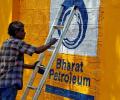
BPCL is a high revenue-earning public-sector undertaking (PSU) and plans to privatise it are completely off the table, Petroleum and Natural Gas Minister Hardeep Singh Puri said on Tuesday after assuming charge of the ministry for the second time. "Why would we divest ourselves of highly successful Maharatnas like BPCL," Puri said, arguing the Centre was not in favour of divesting its stake in oil PSUs.

The disinvestment-bound carrier, which is incurring Rs 15 crore loss per day, has huge dues towards oil companies and Airports Authority of India, among others.

Global brokerage firm CLSA has reversed its early tactical shift from Indian equities to Chinese stocks, and has decided to raise India allocation while cutting exposure to China. In its report titled 'Pouncing Tiger, Prevaricating Dragon', CLSA cited challenges facing Chinese markets in the aftermath of Donald Trump's victory in the US elections as the reason for the move. "Misfortune can happen in threes. So it has played out for Chinese equities over the past week.

Union Finance Minister Nirmala Sitharaman on Monday said people are finding current interest rates "very stressful" and urged banks to make them affordable. Speaking at an event organised by State Bank of India, the finance minister said that at present, India requires industry to ramp up and invest in new facilities, and added that lowering lending rates can help achieve the "Viksit Bharat" aspiration.

The GST Council on Saturday postponed a decision on cutting tax rate on life and health insurance premiums, officials said. The 55th meeting of the GST Council, chaired by Union Finance Minister Nirmala Sitharaman and comprising state counterparts, decided that some more technicalities needed to be ironed out and tasked the GoM for further deliberations.

Indian refiners will buy less oil from Saudi Arabia next month as they snap up supplies outside of the Middle East as part of diversification drive amid weakening domestic fuel demand on the resurgence of COVID-19. State-owned Indian Oil Corporation (IOC) and three other refiners have sought just 65 per cent of the monthly average of about 15 million barrels from Saudi Arabia in May, three sources with knowledge of the matter said. The move follows tensions between India and Saudi Arabia over the Kingdom's hawkish stance on boosting production to cool prices.

Taking advantage of a Russian offer to sell its crude oil cheap and bear the cost of insurance and transportation, India may import as much as 2 million tonnes (mt), or roughly 15 million barrels of crude, from the sanctioned nation in 2022, Business Standard has learnt. This comes after reports that Indian Oil Corporation (IOC) bought 3 million barrels of Russian Urals from trader Vitol for May delivery. This will be on cost, insurance and freight (CIF) model, where the seller incurs the costs and pays the freight, including insurance charges.
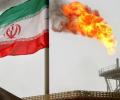
Iran has offered to help India meet its energy needs by relaunching rupee-rial trade for export of oil and gas, said Iranian ambassador to India Ali Chegeni. Chegeni said if both the countries resume rupee-rial trade, bilateral trade can touch $30 billion. Iran used to be India's second largest oil supplier but New Delhi had to halt imports after the former US president Donald Trump withdrew from the nuclear deal with Iran and re-imposed sanctions on its oil exports.
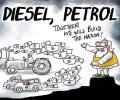
The government on Friday slapped an export tax on petrol, diesel and jet fuel (ATF) while also joining nations like the UK in imposing a windfall tax on crude oil produced locally. A Rs 6 per litre tax on export of petrol and ATF and Rs 13 per litre tax on export of diesel is effective from July 1, finance ministry notifications showed. Additionally, a Rs 23,250 per tonne tax was levied on crude oil produced domestically.

'The shifts in US involvement in global conflicts and geopolitical alliances could introduce uncertainties.'

Carter was in politics, but not a politician, certainly not a transactional politician, points out Shreekant Sambrani.

Ahead of a meeting of oil producers' cartel OPEC, India on Tuesday said the current oil prices are "very challenging" and rates need to be a "little bit sober" lest they impact a consumption-led recovery of the global economy. Oil Minister Dharmendra Pradhan, who last week again urged OPEC to phase out its production cuts, said India is a price-sensitive market and it will buy oil wherever it gets competitive rates. The rebound in international oil prices from lows hit last month on the back of demand recovery has led to a spike in petrol and diesel retail prices in India.

Reliance Industries Ltd has consolidated its balance sheet after the previous round of capex and is ready for the next level of growth, its chairman and managing director Mukesh Ambani said outlining plans from net zero to roll-out of True5G telecom network and retail. In the firm's latest annual report, he said in the world of volatility and uncertainty, India is shining as a beacon of stability and prosperity.

Indian Oil Corporation (IOC), the nation's largest oil firm, has walked away with half of the natural gas that Reliance Industries Ltd and its partner bp of the UK offered in the latest auction of the fuel used to generate power, produce fertilizer, turned into CNG and used for cooking purposes. IOC got 2.5 million standard cubic meters per day out of the 5 mmscmd of gas auctioned last month, sources with knowledge of the matter said. The oil refining and marketing company, which was the top bidder even in the previous auction of gas from the eastern offshore KG-D6 block of Reliance-bp, bid the volumes on behalf of seven fertilizer plants.
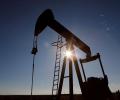
A fall in crude oil price and Aramco's $75 billion annual dividend commitment may have delayed Saudi company picking a stake in Reliance Industries Ltd's oil-to-chemical unit (O2C), research firm Jefferies said. Richest Indian Mukesh Ambani had in August 2019 announced talks for the sale of a 20 per cent stake in the O2C business, which comprises its twin oil refineries at Jamnagar in Gujarat and petrochemical assets, to the world's largest oil exporter. The deal was to conclude by March 2020 but has been delayed for reasons not disclosed by either company.
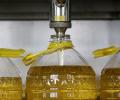
The government has reduced the tariff value for import of edible oil, including palm oil, by up to $112 per tonne, a move which experts said can lead to lower domestic prices. The Central Board of Indirect Taxes and Customs (CBIC), through a notification, has cut the tariff import value of crude palm oil by $86 per tonne, and of RBD and crude palmolein by $112 per tonne each. It also reduced the base import price of crude soyabean oil by $37 per tonne. The changes in tariff value of edible oil are effective from Thursday (June 17).

Indian Oil Corporation Ltd will start manufacturing fuel used in F1 racing in three months' time.

After depreciating 0.32 per cent against the dollar in October so far, the rupee is expected to hold ground against the greenback in the current quarter on the back of robust inflows. According to the median of a Business Standard poll of 10 respondents, the rupee is seen trading around 84 per dollar till the end of December. "In India's case, at least the bond and cash related inflows will continue.

'2019 was fought on delivery. But in 2024, you can see the before and after effects.'

India's production of crude oil, which is refined to produce petrol and diesel, continued to decline in November, with lower output from state-owned firms leading to an over 2 per cent drop, official data released on Tuesday showed. Crude oil production in November was 2.43 million tonnes, down from 2.48 million tonnes a year back and 2.5 million tonnes in October 2021. Oil and Natural Gas Corporation (ONGC) produced 3 per cent less crude oil at 1.6 million tonnes in November due to delays in mobilising equipment at western offshore fields.

Lisa Curtis, who served as deputy assistant to President Trump and as National Security Council senior director for South and Central Asia from 2017 to 2021, said she expected the same bumps for India and the US, as in Trump's first term, including tariff, dependence on Russia over arms supply and oil purchase from Iran. Curtis, however, said both countries could never enter an alliance but develop a partnership that is "short of an alliance". She hoped them to achieve a cooperation that deters China, but also prepares both countries in case of a crisis or conflict, be it in the Taiwan Strait, the South China Sea, or another flare-up on the India-China border.

Ukraine and Russia need to engage with each other to find a solution to the ongoing conflict between them, India said on Friday after Prime Minister Narendra Modi held wide-ranging talks with President Volodymyr Zelenskyy in Kyiv under the shadow of the raging war.

If international crude oil prices zoom past the current level of about $90 per barrel and move towards $100 and beyond, middle-class consumers are not going to keep quiet about their discomfort, points out Arun Balakrishnan, former chairman and managing director, Hindustan Petroleum.

India, the world's third-biggest oil consumer, has conveyed to OPEC countries its concern over high oil prices that are threatening to impact the nascent economic recovery after the devastating pandemic. New Oil Minister Hardeep Singh Puri has made phone calls to key OPEC nations to convey the desire for an affordable price for consumers. After calling his counterparts in Qatar and the UAE, he called Organization of the Petroleum Exporting Countries (OPEC) kingpin Saudi Arabia on Thursday evening.

The FMCG industry hopes for a revival in consumption growth in 2025 with some 'green shoots' already visible, after having a challenging year amid escalating input costs and a double-digit rise in food inflation, which ultimately slowed down the pace of the urban market growth in the second half of 2024. Soaring prices of commodities such as palm oil, coffee, cocoa and wheat forced FMCG players to go for a hike of 3 to 5 per cent or resort to shrinkflation by reducing pack sizes and grammage to retain attractive price points, fearing a volume loss.
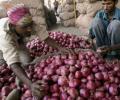
However, truckers have spared other vegetables, fruits, fuel and milk from the strike.
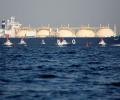
Oil and LNG prices are likely to shoot up if Iran is to block Strait of Hormuz, through which countries like India import crude oil from Saudi Arabia, Iraq and UAE, leading to a spike in inflation, analysts said on the Iran-Israel conflict. The Iran and Israel conflict has escalated over the last few days. Iran first launched drone and rocket attacks on Israel, which retaliated by firing a missile. Crude oil prices have hovered around USD 90 per barrel since the conflict.
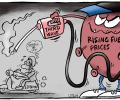
A surge in international oil prices may translate into an increase in the retail selling price of petrol and diesel in India as oil companies face extreme margin squeeze, sources said. Petrol and diesel prices have remained unchanged for 12 days but now the international rate surge is exerting pressure. Current prices of petrol and diesel in the international market are higher by around $4-6 per barrel as compared to average prices during August. However, no increase in retail prices has been affected by oil companies so far, sources said.

Equity benchmarks Sensex and Nifty on Thursday gave up all early gains to settle lower as surging oil prices amid the ongoing conflict between Russia and Ukraine hit investor sentiment. The 30-share BSE Sensex started the trade on a higher note and jumped 527.72 points in morning deals to a high of 55,996.62. However, during the afternoon trade it surrendered all its early gains and finished at 55,102.68, lower by 366.22 points or 0.66 per cent.

The rupee tumbled 3 per cent against the US dollar in 2024 as concerns over slower economic growth and a stronger greenback in global markets weighed, but it was among the least volatile currencies in the world and the headwinds may be less intense in the coming year.
OPEC's move to cut output has pushed up oil prices. From here it could go either way: oil could reach $100/barrel or an analysis of demand and supply might follow, say Abheek Barua & Bidisha Ganguly.
India's crude oil import bill is set to exceed $100 billion in the current fiscal year ending March 31, almost double its spending last year, as international oil prices trade at seven-year highs. India spent $94.3 billion in the first 10 months (April-January) of the ongoing financial year that started April 1, 2021, according to data from the oil ministry's Petroleum Planning & Analysis Cell (PPAC). It spent $11.6 billion in January alone when oil prices had started to surge.
